3D Skills Sprouted from a Two Dimensional Seedling
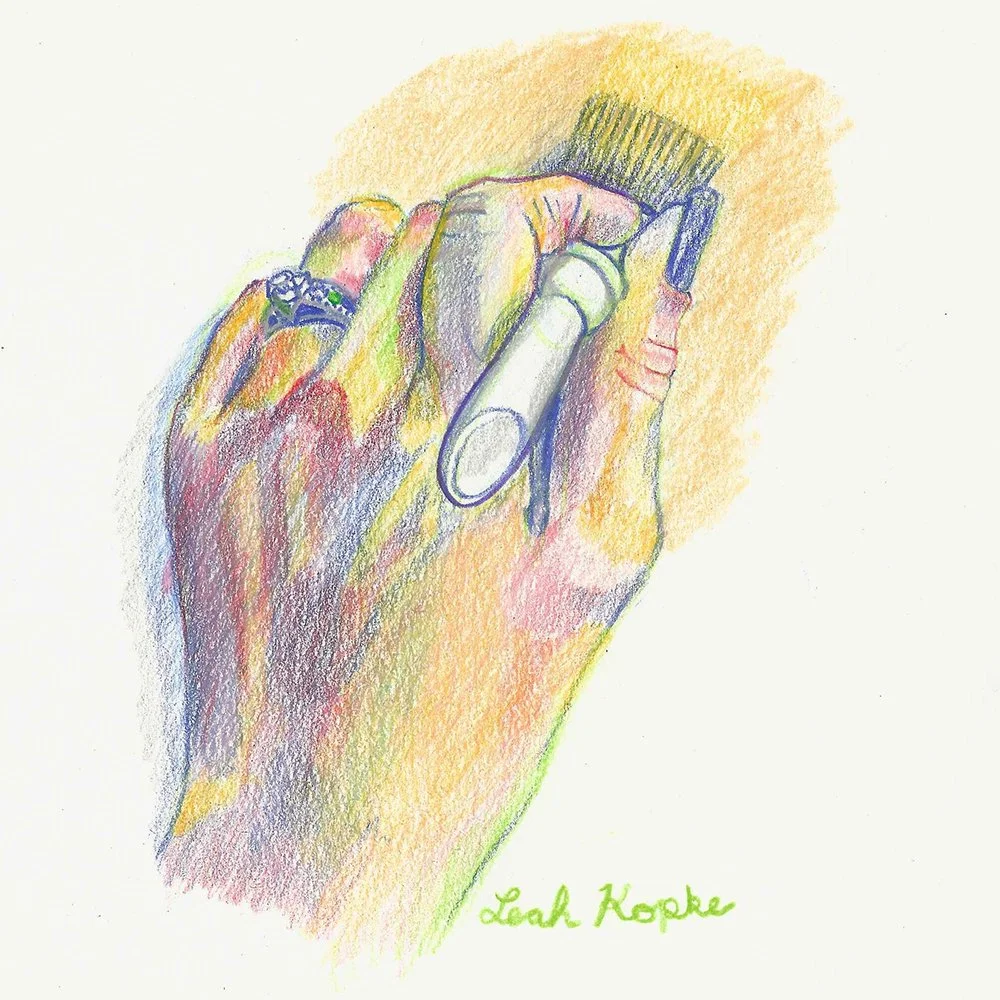
Artist and Author Leah Kopke
Editor Ezra Blocker
The Story is More Than a Title
My foundation in 3D motion design can be found in ink, colored pencils, chalk pastels, magazine collages, oil paint and acrylic paint. My 3D skills sprouted from 2D seedlings. This part of my history can help other 3D artists learn. Embracing 2D practices can inform 3D skills crucial to learning.
In order to specialize in a 3D niche and build a brand around it, I hid my 2D work and background from social media. I repeatedly clarified to clients and new faces I met that I was a 3D designer and didn't specialize in 2D. While this is true and was helpful for my business, I questioned if this was helpful for teaching on YouTube. 3D Motion Designer is a business title, not my identity; however, I’ve done more than 3D and studied more than 3D.
Practicing 2D taught me color theory through mixing paint, spatial visualization with a pen, and proportions in a figure painting class. 2D taught me resilience, finding peace in color and shapes. I often hear designers say that “you need to focus your energy on practicing one skill to become a master in a niche” and “learning more than one skill in motion design will lead one to becoming a master of none.” While there is truth to that, my business is an exception to this idea. Practicing sketching and painting aid in 3D design skills. They are worthwhile skills for any 3D artist.
The Truth of Optical Illusions
The tactile nature of mixing paint or layering colors teaches us more about color theory than dragging one's mouse to the right color on the computer.
Years ago, I took a figure oil painting class at the Art Institute of Chicago. In that class, I learned that a color’s appearance is dependent on the colors around it. It’s an optical illusion that is important to understand. It also helped me better communicate with a client.
As I was doing a series of product renders for a client, I needed to match Pantone colors precisely for the renderings. My client was concerned the colors weren’t matching the Pantone chip. Color theory allowed me to explain that the rendering matched a Pantone color and the colors around the product made an optical illusion that the colors didn’t match. Understanding color theory helped me better communicate with my client and deliver a final product they were happy with. For each render, I included a sample with the Pantone color swatch which helped ease my client’s concerns about the color matching. My knowledge of oil painting helped resolve my client’s concerns about a series of 3D renders.
Meticulously Crafted Paint Chips
When I studied Industrial Design at University of Cincinnati’s DAAP program, my professor had us tediously mix hundreds of paint chips by hand. With focused eyes, we meticulously cut them out using a drafting table and utility knife. One slip of the hand could mean starting the project from scratch. We needed to rearrange paint chips, creating perfect gradients, and matching them in value. We created gradients exploring saturation as well.
I learned more by doing this the hard way by painting chips without computer assistance. Taking the shortcut wouldn’t have trained my eyes. I dreamt of mixing paint after it consumed my day and never forgot what I learned. While it isn’t necessary to go to college or paint hundreds of paint chips to learn these skills, mixing color by hand with any traditional illustration medium like marker, colored pencil, or paint can help someone learn contrast in value, hue, and saturation. It is a very accessible skill for anyone with the desire to acquire. In my class we practiced with paints that can be obtained very easily and affordably. My professor called doing this on a computer “cheating” and claimed “it wouldn’t teach you anything.” He was right. My teacher's words felt harsh when I was an exhausted student, but I learned so much about color theory when I followed the advice. It changed how I view design.
I use these skills in every 3D client project helping my compositions show contrast where needed. It has improved my lighting in renders. While many may not want to mix hundreds of paint chips, experimenting with color while painting, or drawing can improve anyone's 3D rendering skills. There is still more to learn today by mixing colors.
Spatial Visualization is Pushups
Sketching teaches spatial visualization which aids in 3D modeling. It helps to be able to visualize an object from each angle in your mind while modeling it on your screen. As I studied industrial design, we needed to learn how to sketch spheres, cubes, cylinders, toruses, and cones in perspective without a visual reference. Once these skills are mastered, the idea is you can sketch any object from your imagination, including objects that don’t yet exist.
A professor told our class, “By the end of this sketching class, you’ll be able to imagine an object and rotate it 360 degrees in your mind seeing every detail.” This is a skill that can be learned with practice.
Sketching is like doing pushups each day. Your body can do more than you realize, but you can’t realize that potential until you practice consistently. At least a portion of my 3D modeling abilities come from my sketching background. After all, what does sketching and 3D models have in common? Points, lines and perspective. It is all connected but we treat disciplines like they are separate. One informs the other and all are interconnected.
Embracing the Interconnected
While it may help my business’s brand to focus on posting work from my 3D niche, restricting myself from exploring 2D would actually restrict my growth as a 3D artist. We should all embrace experimentation in other forms of art, even if they aren’t the ones that pay the bills. You never know how skills learned along the way can translate over and save a client project or stimulate your own artistic growth. Skills in 2D art and design have empowered my 3D motion design career. Branching out into other art forms can empower yours as well.